Setting the Stage
One of the earliest schools of East Asian martial arts (certainly one of the most famous) is the Shaolin Monastery in China. Established in the 5 th century CE on the slopes of the sacred mountain Mount Song, the Shaolin Monastery was (and continues to be) a prominent site for Buddhist practice and martial art training. Legend has it that Shaolin was founded by
Bodhidharma, the Indian pilgrim who travelled to China with a vast archive of precious teachings to share. Among these, apparently, were the martial arts that served as the founding blocks for what eventually became known as kung fu.
In the 17 th century, some of these practices reached the shores of Okinawa (an island in present-day Japan). Okinawa has its own history of fighting techniques, indigenous to the local community, known as di (“hand”). When occupying forces overtook the island and forbade locals from carrying swords, these techniques combined with the Chinese practices they adopted, became the foundation for a new martial art. With only the “open hand” (karate) as a weapon, these new and developing techniques provided locals with a means with which to defend themselves when nothing more was allowed.
Mas Oyama
Martial arts were never the popular, worldwide phenomena that we know today. They were often localized practices, with many variations and particular histories. The twentieth century saw an explosion of martial arts interest – much of which can be connected to the complicated geopolitics of the period. Mas Oyama appears on the international stage at the beginning of the 20 th century and becomes one of the great forces of contemporary practice.
Mas Oyama was born as Choi Yeong-eui in a small village in South Korea in 1923. At the age of nine, he began studying martial arts with a Chinese farmer working on his land. At the age of fifteen, he left Korea for Japan. In the hopes of being more easily integrated into Japanese culture, he shed his Korean name and took on the name of his host family. He thus became Masutatsu Oyama.
He discovered Gishin Funakoshi, an Okinawan teacher credited with introducing karate to Japan, and studied with him for many years. Meanwhile, he also volunteered for Japanese military service and participated in a few special military events.
During this time, however, he got himself into some trouble. Japan was losing the war and sending its young men on suicide missions as kamikaze pilots. Oyama is said to have become frustrated, often picking fights with US military police in the streets. He even joined a local gang, his physical prowess serving as an asset that appealed to dangerous crowds.
During this time, however, he got himself into some trouble. Japan was losing the war and sending its young men on suicide missions as kamikaze pilots. Oyama is said to have become frustrated, often picking fights with US military police in the streets. He even joined a local gang, his physical prowess serving as an asset that appealed to dangerous crowds.
But Mas Oyama was determined to live a better life. He redirected his energies towards the spirit of martial arts training. He studied Goju-ryu and Judo and took on the Buddhist practice of the Nichiren school of Buddhism. He spent 14 months on Mount Minobu practicing these traditions. When he returned to the city in 1947, he entered the first All Japan Karate Championship and won.
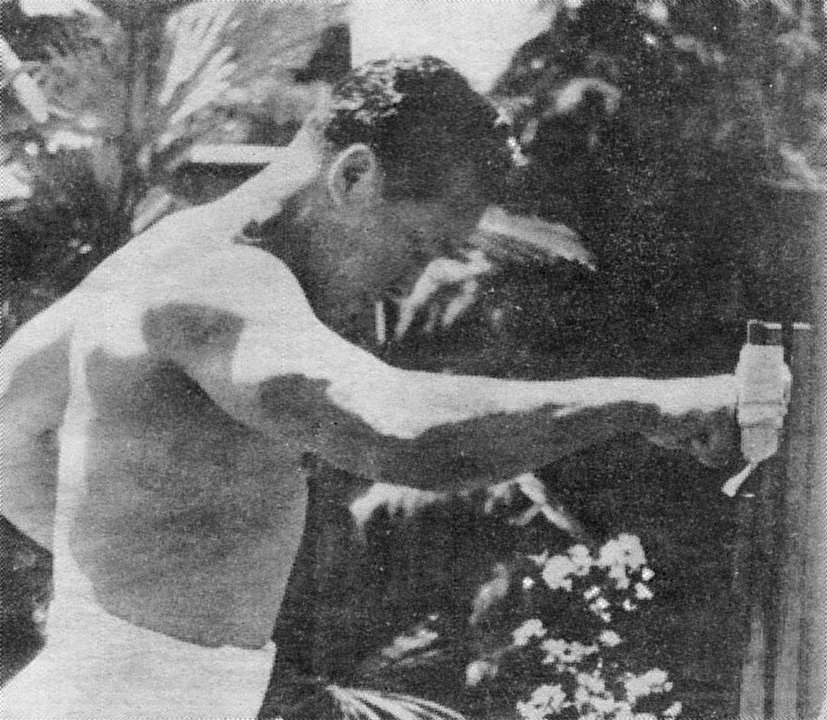
In 1948, Mas Oyama decided to return to isolated training. He hoped to complete the traditional three-year practice. With just a few books and some basic necessities, Oyama isolated himself on Mount Kiyozumi, where he would remain for the next 18 months. He imposed an extreme discipline on himself, with twelve-hour days, using the natural elements to strengthen himself. He sat beneath icy waterfalls, used stones and tree trunks to harden his hands, jumped over bushes, and raced up steep mountain slopes. In the evenings, he studied and practiced zazen (meditation). He was following a regimen similar to one of the most rigorous practices in the Buddhist world: the “Marathon Monks” who practice on Japan’s Mount Hiei.
Kyokushin
When he emerged from his mountain retreat, Mas Oyama was finally ready to share the practices he had been working so hard to develop. He opened his first school in 1953, introducing the world to what would soon become known as Kyokushin: Ultimate Truth. Mas Oyama’s techniques caught on like fire, with new schools opening all over the world. Kyokushin promised to strip away anything considered inessential, so that stances became more effective and strikes
were uncompromised.
Kyokushin became famous for its full-contact sparring under Mas Oyama. Without protective gear, sparring in this school was direct and penetrating. It was soon considered the most powerful full-contact karate in the world. Kyokushin today boasts of more than 12 million practitioners in 120 countries.
Kyokushin is a powerful fighting technique, but its most profound principle is unwavering: as Mas Oyama writes in his book, What is Karate, serenity is the most important quality one can strive for. Whether one is breaking boards, sparring on the tatami, or practicing kata, karate has much more to offer than physical force. It is first and foremost about the state of one’s mind.
Further Reading
Green, Thomas A. and Joseph R. Svinth. Martial Arts of the World: An Encyclopedia of History and Innovation. 2 volumes (Santa Barbra: ABC-CLIO, 2010).
Lorden, Michael J. Oyama: The Legend, the Legacy (Burbank: Multi-Media, 2000).
Shahar, Meir. The Shaolin Monastery: History, Religion, and the Chinese Martial Arts (Honolulu: University of Hawaii Press, 2008).